ReverseMortgageLondon.ca walks through home renovations for seniors in London, Ontario: what older London houses often need, what each change involves, and how the house’s own value can pay for the work. The goal is a home you can keep living in safely.
Why so many London houses need changes
A large part of London’s housing is decades old. In the 2021 Census, 22.4% of the city’s occupied homes were built in 1960 or earlier, and another 29.9% between 1961 and 1980 (Statistics Canada, 2021 Census Profile, London). Almost half, 48.8%, were single-detached houses.
A house from those years may have a tub with a high side, steps at every door and all the bedrooms upstairs. Each of those can become hard to manage with a walker, after a fall or after surgery.
Bungalows kept their value best this year
One-storey homes matter to anyone planning to stay in their home. In September 2026, the bungalow benchmark was $443,500 in London East, $565,000 in London South and $653,000 in London North (LSTAR / CREA, September 2026 report).
Bungalow benchmarks were the only home type up year over year in all three London areas, rising 2.0% to 2.6%. Two-storey, townhouse and apartment benchmarks fell over the same 12 months (same report).
A bungalow already has the kitchen, bathroom and bedrooms on one floor. That usually leaves the bathroom and the front steps as the main projects.
Changes that make a London home easier to live in
A walk-in shower
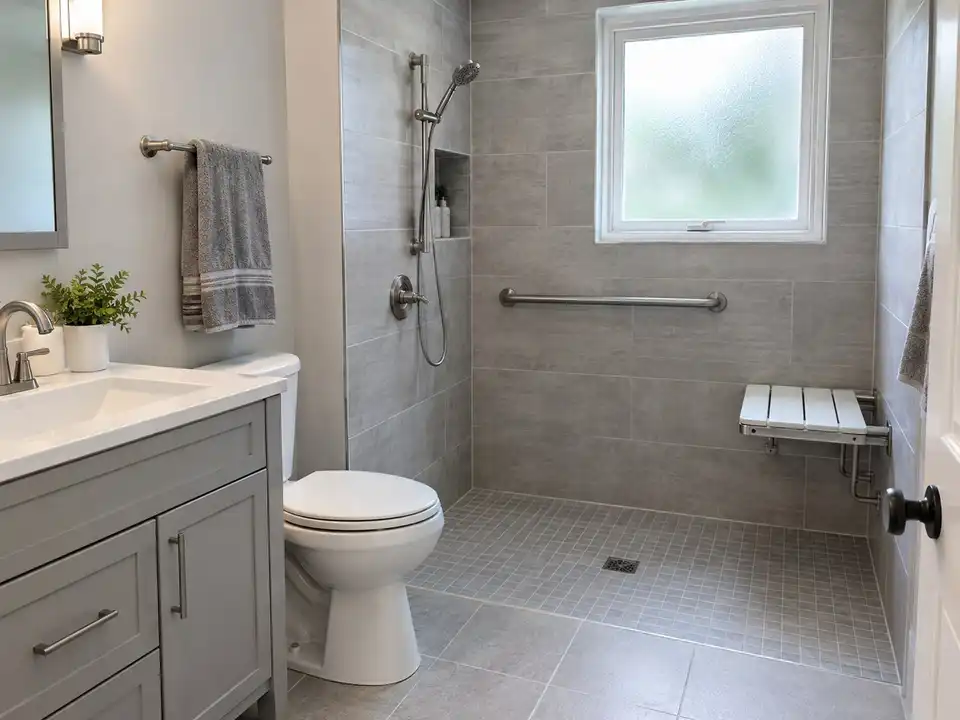
A low-threshold or curbless shower replaces the step over a high tub wall. Grab bars, a built-in seat and a handheld shower head often go in at the same time.
A main-floor bedroom
Turning a main-floor den or dining room into a bedroom means the stairs become a choice, not a daily climb. Adding or enlarging a main-floor bathroom often goes with it.
A stair lift
A stair lift is a powered seat that travels along a rail fixed to the staircase. It suits a two-storey house where moving the bedroom downstairs isn’t practical.
A ramp and wider doorways
At the front or side door, a ramp replaces the steps for a walker or wheelchair. Some doorways also need widening so a wheelchair can pass through.
Building permits
The City of London says building permits are required for most construction, renovation and alteration projects (City of London, building permits). Its building division can confirm whether your project needs one before work starts.
A self-contained unit for a caregiver or family
Some homeowners add a separate unit, so a caregiver or an adult child can live on the same lot. The City calls these additional residential units (ARUs), and each one has its own kitchen, washroom and separate entrance (City of London, additional residential units).
Every ARU needs a building permit and a residential rental unit licence (same page). The City’s ARU Construction Grant closed once it was fully allocated, covering permits issued April 29 to September 7, 2026 (City of London, community improvement incentives). The ARU Loan, for up to $45,000 or the cost of eligible work, was still listed.
The additional residential unit guide for London covers the rules, the costs and the steps.
The federal Home Accessibility Tax Credit
This is a non-refundable federal tax credit on up to $20,000 a year of eligible home accessibility expenses (Canada Revenue Agency, line 31285). The person it’s for must be at least 65 by December 31 of that tax year, or be eligible for the disability tax credit. The agency calls that person a qualifying individual.
The renovation must improve access, mobility or function in the home, or reduce the risk of harm. A ramp and handrails are among the examples the agency gives. Keep every receipt, and ask whoever prepares your return how to claim it.
Paying for the work from your home’s value
A reverse mortgage lets a London homeowner 55 or older borrow against the house and still keep it. You remain the owner, and while the builders are in, there are no required monthly mortgage payments to make. The City of London tax bill, the home insurance and the upkeep keep coming to you, and the London property tax guide shows the 2026 rates.
For example, an illustrative couple, the younger spouse 70, owns a bungalow at London South’s September 2026 benchmark of $565,000 (LSTAR / CREA, September 2026 report). They could borrow up to about $299,000. At 65 the ceiling would be up to about $286,000, and at 75, up to about $326,000.
That ceiling includes paying off any current mortgage. If the couple still owes $40,000, it is cleared at closing from the same money, and up to about $259,000 is left. They can take only what the renovation needs. The table runs the same ages on a bungalow in each area, with London South highlighted, and the London reverse mortgage calculator does it for your own figures.
| Area | Benchmark price | At 65 | At 70 | At 75 |
|---|---|---|---|---|
| London North | $653,000 | $330,000 | $345,000 | $377,000 |
| London South | $565,000 | $286,000 | $299,000 | $326,000 |
| London East | $443,500 | $224,000 | $234,000 | $256,000 |
Benchmark prices for September 2026 from the London and St. Thomas Association of REALTORS (MLS® Home Price Index: the value of a typical home of that type). The amounts apply about 50.5% at 65, 53% at 70 and 58% at 75, the top of what the highest-lending products allow. Amounts are rounded to the nearest $1,000. Your own home's appraisal sets the real number.
Taking the money in stages
There’s no need to draw it all at once. You can take enough for the contractor’s deposit and draw more as the work moves along. Until a draw happens, that money costs you no interest. Some lenders charge a fee for each later draw.
Lenders also check the state of your London house as part of approval. A repair that’s already scheduled with a contractor can sometimes be included in the mortgage. In that case the lender holds back the money for it until the job is done.
What it means for your family later
Each year, interest is added to the balance. As the bungalow figures above show, London home values can rise too, and in many years that growth offsets part or all of what the interest added.
You can never owe more than your home is worth when the mortgage comes due, as long as taxes, insurance and upkeep are kept up.
How the help reaches you
Only four lenders offer reverse mortgages here: HomeEquity Bank (CHIP), Equitable Bank, Home Trust and Bloom. For your renovation, Richard Hopkins, Mortgage Broker, compares every reverse mortgage lender in Canada, which means all four. His first email sets out how much your London home could provide and which lenders fit it. It also asks how much you want to put toward the renovation.
Family can be copied on every email about the renovation. An appraiser visits the house once. Apart from that, the only face-to-face meeting is with a lawyer you choose, for independent legal advice.
Sometimes a HELOC (home equity line of credit), or a different route, suits the renovation instead. You get a recommendation based on your situation, even if it’s not a reverse mortgage. London’s one-time costs are listed in the London reverse mortgage cost guide.
What Richard does for you
- Works out what your London home could provide for the work
- Compares every reverse mortgage lender in Canada for your home
- Plans a lump sum, or part now and more later
- Explains how needed repairs affect approval
- Shows when a HELOC or another option fits instead
- Keeps your family copied on every email, if you like
- Guides each step from the appraisal to closing
- Helps you find a lawyer for independent legal advice
London guides on this topic
- Can you add an additional residential unit to your London, Ontario home, and how would you pay for it?
- London, Ontario property tax in 2026: how much is the bill, and what help do seniors get?
- What does a reverse mortgage cost in London, Ontario?
Sources
Figures checked October 16, 2026.
- Statistics Canada, Census Profile 2021, City of London (CSD 3539036)
- LSTAR / CREA, Residential Market Activity and MLS® Home Price Index Report, September 2026
- City of London, Building permits
- City of London, Additional residential units
- City of London, Community improvement incentives (ARU grants and ARU Loan)
- Canada Revenue Agency, Line 31285: Home accessibility expenses